
The Digital Marketing Toolkit Every Commercial Property Should Have
- Digital Growth, Process & Proof
- September 15, 2026
- 13-minute read
A commercial property rarely exists in only one place online.
It may appear on a dedicated website, a property management company’s site, brokerage platforms, leasing brochures, email campaigns, social media, maps, presentations, search results, and third-party listings. Prospective tenants, brokers, visitors, owners, and other stakeholders may encounter the property through any one of those channels before ever speaking with someone directly.
The challenge is that the materials supporting those touchpoints are often created independently.
Photography may come from one vendor. A leasing brochure may have been designed at a different time. Drone footage may live on someone’s hard drive. Floor plans might exist only inside an older PDF. Property information may be updated on one platform but remain outdated somewhere else. Every new marketing request can become another small project built from whatever files happen to be available.
Individually, those assets may all be perfectly good.
Collectively, however, they may not function as a system.
A stronger approach is to build a coordinated digital marketing toolkit: a reusable collection of web, visual, geographic, leasing, and promotional assets that can support the property wherever it needs to appear.
The goal is not necessarily to create more marketing.
It is to make sure the property has the right assets, organized well, and designed to work together.
A Commercial Property Is Marketed in More Places Than You Think
A prospective tenant might first encounter an office property through a brokerage listing. Someone evaluating a retail center may discover it through a tenant search, a map result, social media, or signage at the property. A broker may receive a leasing brochure by email, while ownership reviews the same property through a presentation or management report.
Each channel has different requirements, but the property should not have to reinvent itself every time it appears somewhere new.
A coordinated toolkit gives those channels a shared source of accurate information, imagery, branding, and media. The property may need to communicate through:
A standalone website or microsite
A property management or brokerage website
Leasing platforms and digital listings
Leasing brochures and presentations
Search results and maps
Email and direct outreach
Social media
Tenant-facing information
Printed material connected to digital resources
10
Assets That Should Be in a Commercial Property Digital Marketing Toolkit
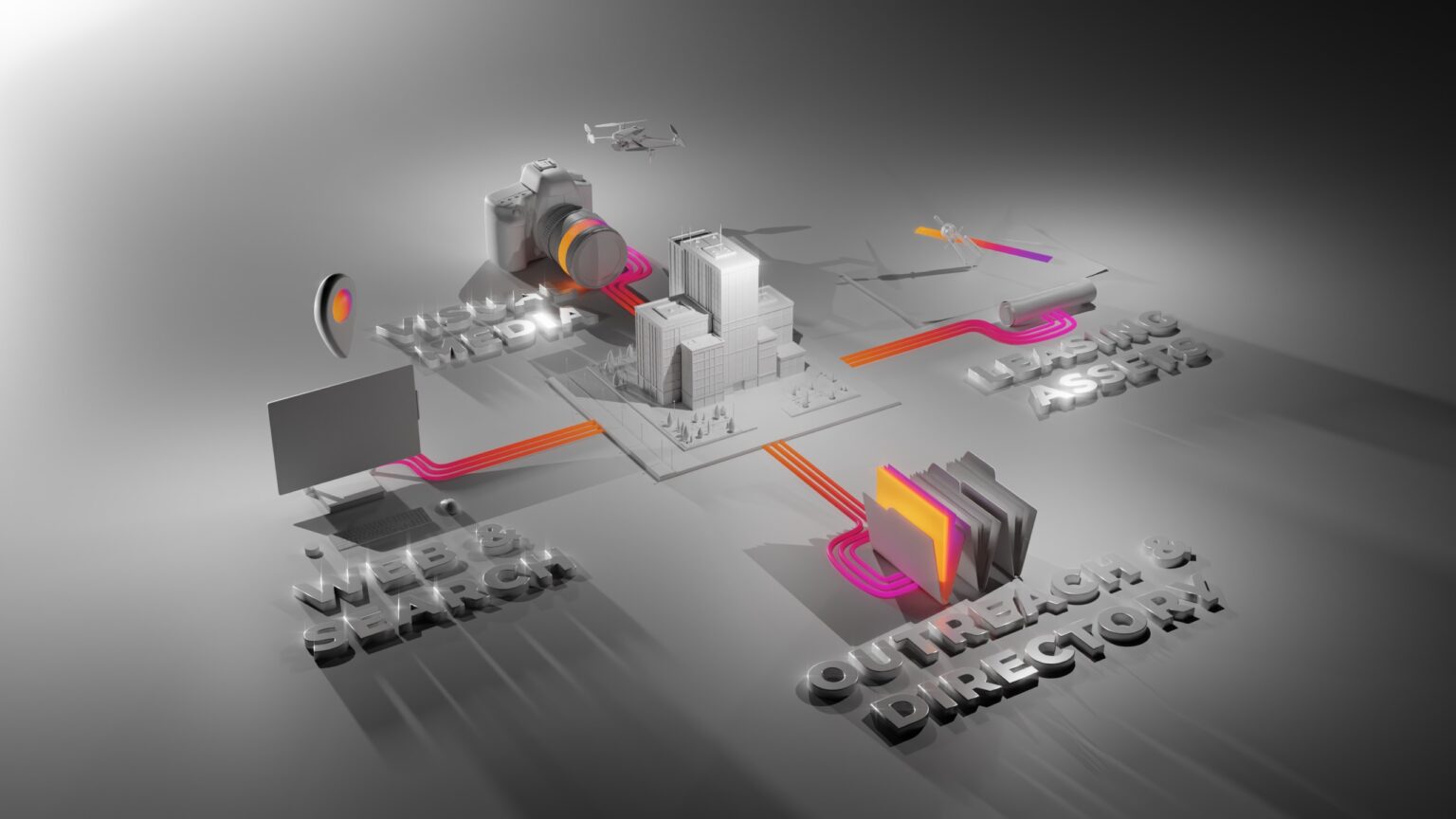
A Dedicated Property Web Presence
1.
A property website can serve as the central digital destination for information that might otherwise be scattered across listings, PDFs, emails, and third-party platforms. That does not mean every property necessarily needs its own independent domain and full website. Depending on the situation, the right solution may be a standalone property website, focused microsite, or a substantial property section within a management or brokerage website.
The important part is having an authoritative destination where current information can be organized clearly. A useful property web presence might include photography, amenities, available spaces, leasing contacts, maps, downloadable documents, location information, tenant details where appropriate, and other property-specific resources.
It also gives the management or leasing team greater control over how the property is presented rather than relying exclusively on third-party listing formats. For properties that need a more purposeful digital destination, a thoughtfully planned custom website or microsite can become the hub that the rest of the marketing toolkit supports.
Professional Property Photography
2.
Strong photography remains one of the most versatile assets a property can have. Useful commercial-property photography may include exterior architecture, building entrances, interior common areas, amenities, streetscape, parking and access, signage, architectural details, and the surrounding environment.
But the value of a professional shoot goes beyond producing a folder of attractive images.
Photography becomes considerably more useful when it is planned around where those images will eventually appear. A wide composition may work well as a website hero image. Another photograph may need additional negative space for leasing-brochure typography. Vertical compositions can support mobile and social media. Detailed architectural photography may be useful in presentations or branding materials. Thinking about those downstream uses before the shoot allows one production session to support many different marketing needs.
Drone Photography and Aerial Video
3.
Aerial media can provide something ground-level photography cannot: context. For commercial properties, drone photography and video can help communicate, property scale, parking and circulation, road access, nearby highways, adjacent development, visibility, property surroundings, major landmarks, and the relationship between the property and the broader area.
That makes aerial production especially useful when location and access are important parts of the property’s story.
The strongest drone content does more than show a building from above. It helps explain where the property sits within the environment around it. Aerial stills can support websites, brochures, listings, presentations, maps, and social content. Video can also be integrated into larger property films or short-form digital campaigns.
Property Video
4.
Video provides an opportunity to combine several parts of the toolkit into one narrative. A property video might incorporate ground-level footage, drone footage, professional photography, motion graphics, maps, property facts, typography, voiceover, and leasing information. Unlike a static brochure or photo gallery, video can guide the viewer through the property in a deliberate sequence.
It can highlight arrival, exterior scale, common areas, amenities, available space, location, and surrounding context while reinforcing a consistent visual presentation. The same core footage can also be edited into shorter assets for social media, email, presentations, or leasing outreach. This is one reason it can be useful to think about creative production as part of the broader property-marketing system instead of treating photography, video, and design as unrelated purchases.
A Leasing Brochure or Digital Property Sheet
5.
The PDF brochure remains useful for a reason. It is portable, familiar, easy to email, and gives brokers, leasing teams, ownership, and prospects a convenient summary of the property. A strong leasing document might include property overview, key selling points, professional imagery, amenities, available space, maps, demographic or market information where appropriate, leasing contacts, and property specifications. The problem is not the PDF format.
The problem occurs when the brochure and the rest of the property’s digital presence appear to represent different versions of the same asset. Photography, typography, messaging, maps, logos, and property facts should ideally draw from the same underlying system used by the website and other marketing channels. A leasing brochure should therefore be more than a standalone document. It should be one expression of a consistent property identity.
Maps, Site Plans and Location Graphics
6.
For many commercial properties, geography is part of the story. A simple address does not always communicate how someone enters the property, which roads provide access, where parking is located, how buildings relate to one another, where neighboring tenants are positioned, what surrounds the property, or how close it is to major destinations. Maps and plans can turn that information into something easier to understand.
Potential assets may include site plans, access maps, parking diagrams, tenant maps, major-road graphics, nearby points of interest, transportation connections, trade-area graphics, and building orientation diagrams. These assets are especially useful because they can often be reused across websites, leasing documents, presentations, listings, and email campaigns, while good information design makes location easier to understand at a glance.
Floor Plans and Space Information
7.
For properties with available commercial space, floor plans can move a prospect from general interest toward a more concrete evaluation. Depending on the property, useful space information may include suite plans, dimensions, square footage, space configuration, available units, downloadable plans, interior layouts, and building or floor location.
Some properties may need highly detailed plans, while others may only need a clear representation of where a space sits within the building or center. The key is to make the information easy to access and reasonably current so a prospective tenant does not have to search through several unrelated documents simply to understand what space is available.
Search Visibility and Accurate Location Information
8.
A property’s digital toolkit should also help people find accurate information about it. That does not mean every commercial property needs the same search strategy, nor does every property necessarily require its own Google Business Profile. Instead, the broader goal is discoverability through clear property naming, accurate address information, search-friendly website content, location-oriented page structure, maps, nearby landmarks, major-road and access information, consistent property details across relevant platforms, and accurate contact information.
Where a property or associated business appropriately qualifies for a Google Business Profile, maintaining accurate information there can provide another useful discovery point. The larger principle remains the same: people searching for the property should be able to find reliable information without encountering several conflicting versions of it. That makes search visibility and local information part of the digital asset system rather than something added only after the marketing materials are complete.
Tenant Directory and Property Information
9.
For retail centers, mixed-use properties, office campuses, and other multi-tenant environments, the property may need to communicate more than leasing information. Visitors may also need to know which businesses are located there, where tenants are positioned, suite numbers, business categories, tenant websites, hours where appropriate, property amenities, and relevant contact information.
A well-maintained tenant directory can make a property easier to navigate and understand for the people already using it while also strengthening the property’s public-facing presentation by showing the collection of businesses and services available there. The goal is not to transform the property website into a marketing department for every tenant, but simply to provide useful, accurate information that improves the experience of interacting with the property.
A Reusable Social and Outreach Asset Library
10.
One of the easiest ways for property marketing to become inefficient is to start from zero every time someone needs a new graphic, presentation, post, email, or listing. A reusable asset library can reduce that friction by organizing approved photography, drone stills, video clips, social-media crops, property logos, map graphics, property overview graphics, email imagery, leasing presentation assets, branded templates, approved property descriptions, and current property facts.
The objective is not necessarily to maintain an active social-media campaign for every property. It is to make sure useful assets already exist when a new marketing opportunity arises, so when the leasing team needs an email graphic, the management company needs a property image, or a broker needs a presentation slide, they do not have to rebuild the property’s visual identity from scratch.
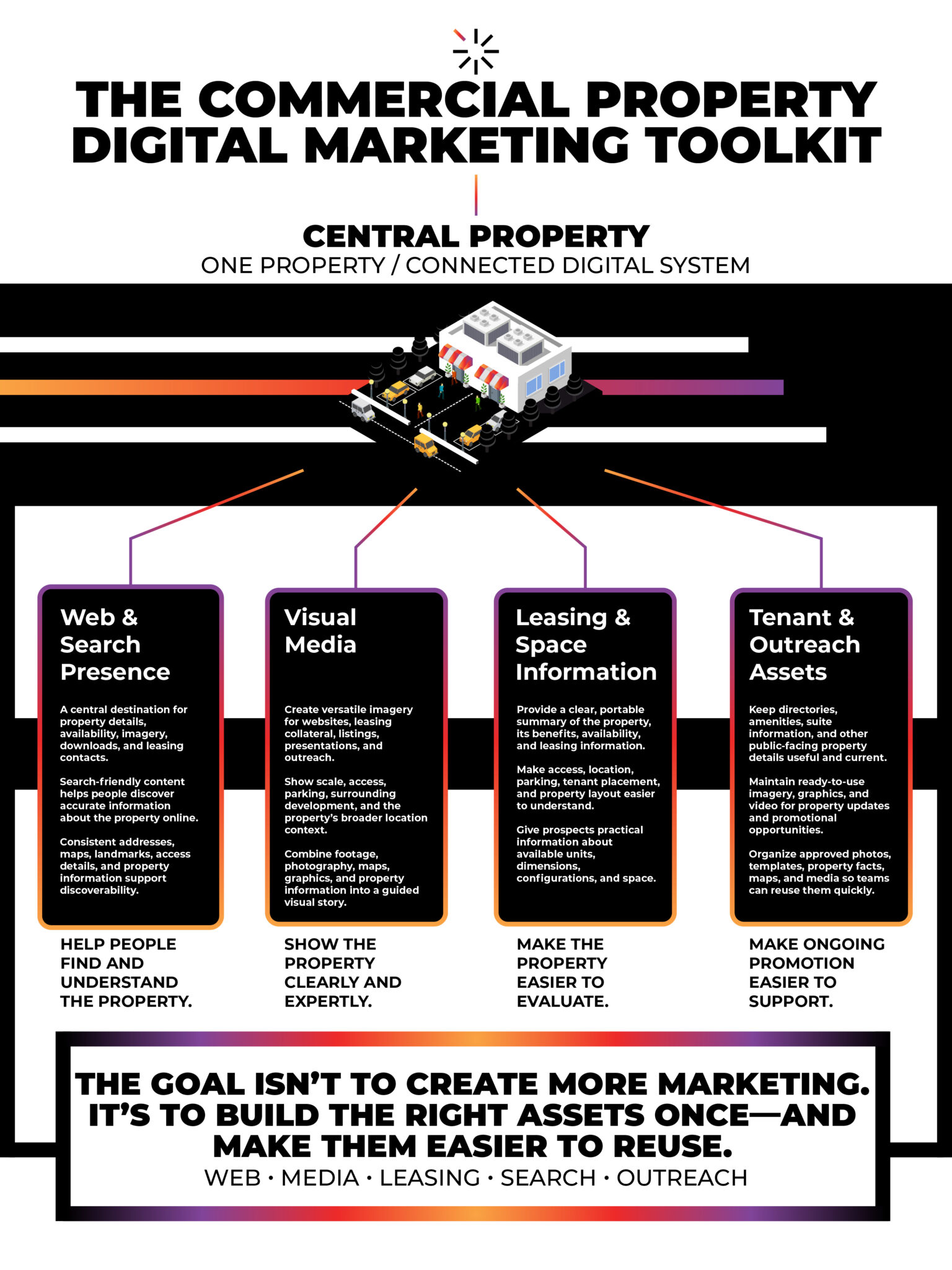
The Toolkit Is More Valuable When the Pieces Work Together
The value of these assets increases when they are planned as parts of the same system. Consider photography. One professionally planned shoot might provide imagery for:
Website → Leasing Brochure → Listing Platforms → Email → Social Media → Presentations
The same principle applies to aerial production:
Drone Shoot → Website → Property Video → Leasing Presentation → Social Clips → Aerial Stills → Location Graphics
Property information can work the same way:
Central Property Data → Website → Brochure → Listings → Maps → Email → Sales Presentations
Instead of creating a different asset from scratch for every channel, strong source materials can be adapted to different contexts. That improves consistency while reducing duplicated work. It is the difference between thinking in terms of individual deliverables and thinking in terms of a property marketing system.
Managed WordPress Website Solutions
Are You An SMB Looking for a Complete Digital Foundation?
Managed WordPress Website Solutions combine website development, branding, SEO, technical infrastructure, and ongoing support into a structured package designed to help businesses launch and grow with confidence. Not every business requires a fully custom engagement. For those looking for a proven framework that combines the most commonly requested services into a streamlined solution, MWWS packages offer a practical starting point. The only question is how much functionality, visibility, and growth support your business is ready for.
Foundation Website Solution
Best for SMBs that need a polished professional website, brand foundation, SEO-ready structure, and essential digital tools.
Advanced Website Solution
Best for SMBs that need additional functionality to support operations, sales, scheduling, education, or customer interaction.
Complete Website Solution
Best for SMBs that need multiple functionality layers, local visibility support, social media setup, and app-like website capabilities.
One Property Shoot Should Produce More Than Photos
A property media session becomes considerably more valuable when production is planned around its final applications before anyone arrives on site. If the only goal is “take some pictures,” the resulting photography may be perfectly good while still leaving several opportunities unused.
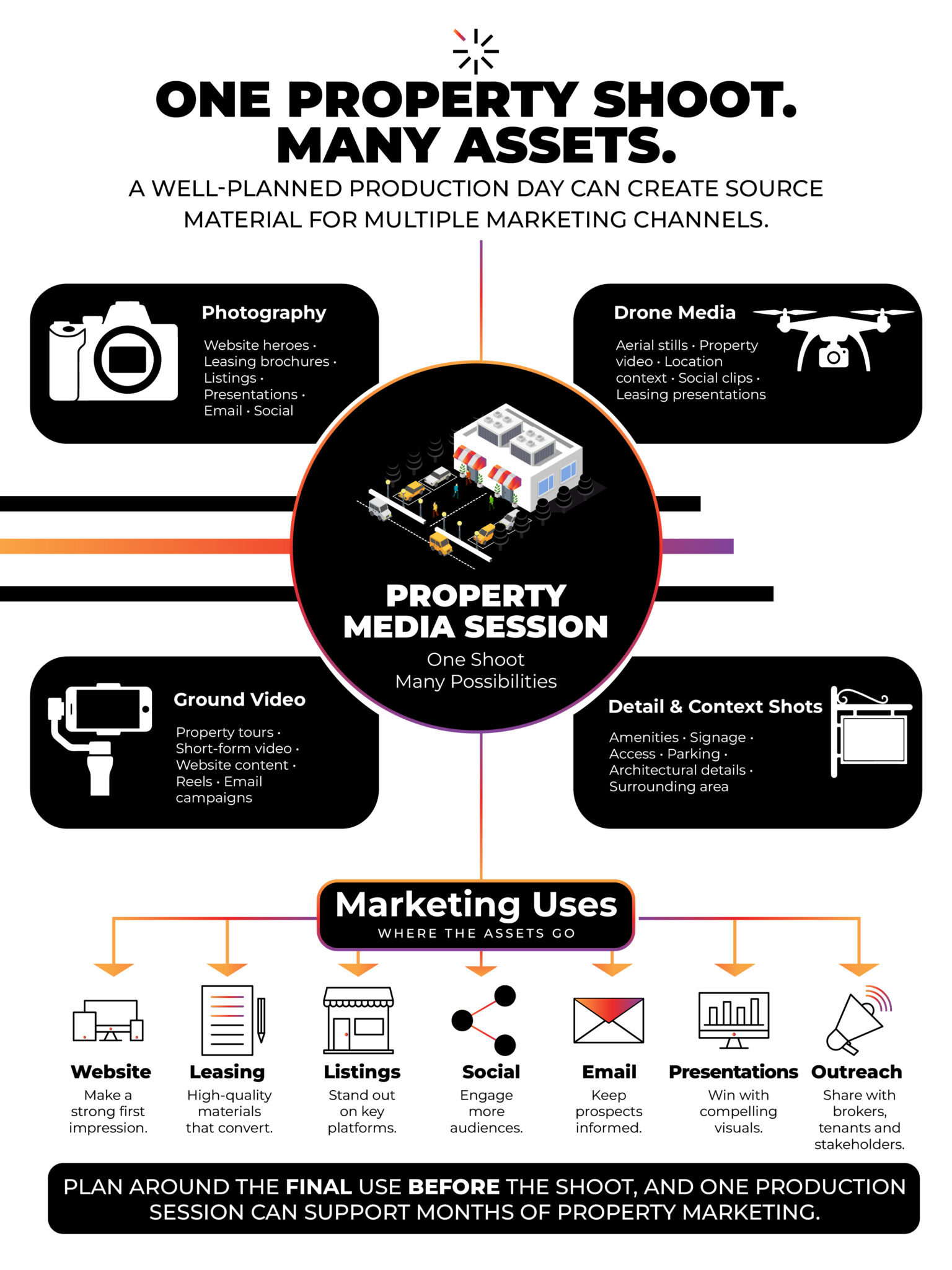
A more intentional production plan might identify the need for wide website hero compositions, horizontal leasing imagery, vertical social crops, architectural details, ground-level video, drone stills, drone video, environmental context, signage, parking and access, and short-form video clips. The objective is not to capture everything imaginable.
It is to understand how the property will be marketed and deliberately produce the source material needed to support those uses. A single well-planned production day can then feed months—or potentially years—of property communications before major visual updates are required.
Build a System, Not a Folder Full of Files
Creating the assets is only part of the job. They also need to remain organized, accessible, and usable over time.
A property can have excellent photography, video, maps, brochures, and branding while still creating unnecessary operational friction if nobody knows which files are current or approved. Multiple versions of the same brochure may circulate, contact information can become outdated, old photography may become mixed with newer imagery, and logos may exist only as low-resolution files. Original source files can become difficult to locate, property descriptions may be copied from outdated documents, vendors may receive inconsistent materials, and teams may be unsure which version of an asset has actually been approved.
A useful digital toolkit should therefore treat organization as part of the marketing system itself. Clear file naming, sensible folder structures, accessible master assets, current property information, approved exports, and properly managed source files can make future marketing considerably easier. A marketing asset becomes more valuable when the people responsible for the property can actually find it, understand it, update it, and reuse it.
Not Every Commercial Property Needs the Same Toolkit
The surrounding area and tenant mix may be particularly important parts of the property’s story.
Retail properties may place greater emphasis on:
- Tenant directories
- Property photography
- Aerial context
- Access maps
- Public-facing web information
- Reusable promotional assets
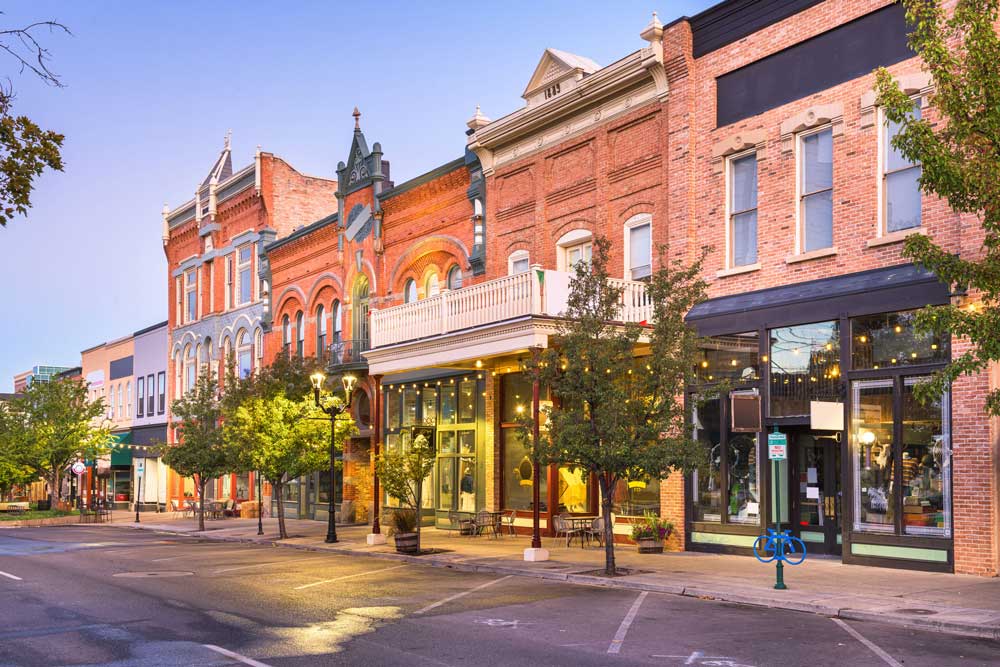
The experience inside the property may matter as much as its exterior presentation.
An office property may emphasize:
- Interior photography
- Amenities
- Available space
- Floor plans
- Leasing collateral
- Property web presence
- Transportation and location

Here, clarity and technical usefulness may matter more than highly promotional presentation.
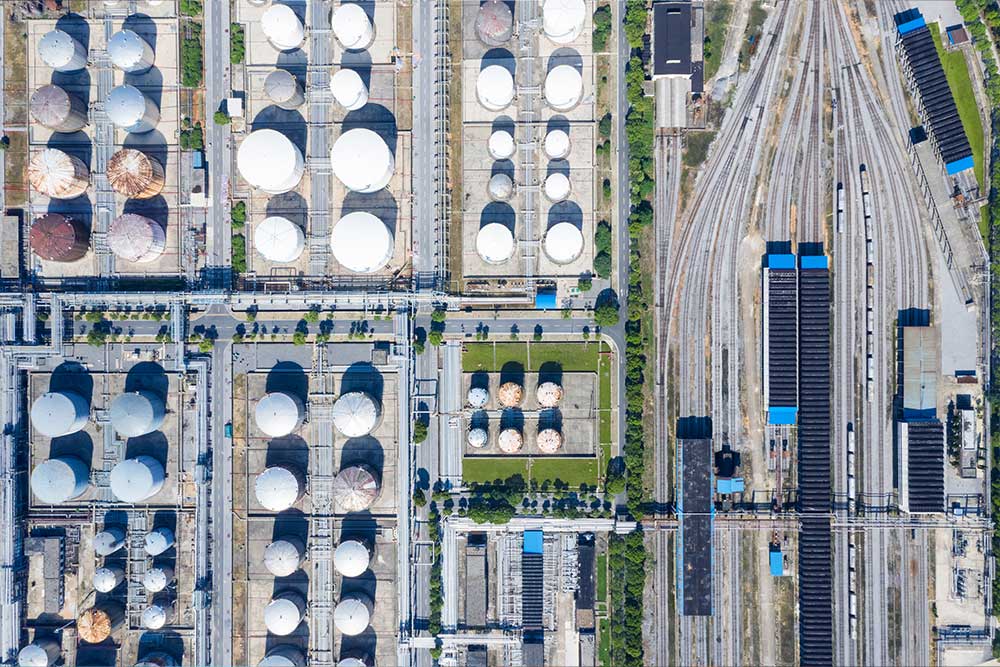
Industrial properties may rely more heavily on:
- Site plans
- Loading access
- Transportation corridors
- Specifications
- Aerial imagery
- Parking or yard information
- Available-space documentation
It may create a stronger need for websites, directories, photography, maps, social content, and frequently updated property information.
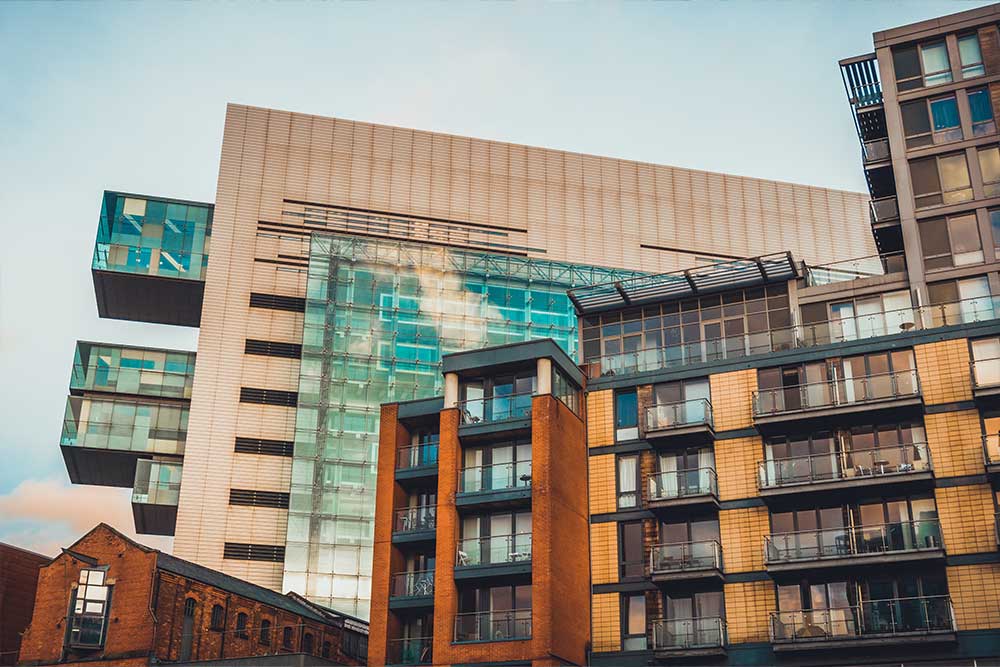
Mixed-use developments may require the broadest digital toolkit because the property can simultaneously communicate with:
- Tenants
- Visitors
- Leasing prospects
- Brokers
- Ownership
- Management
- The surrounding community

Where Property Marketing Becomes Inefficient
A property does not necessarily need more marketing just because the current process feels difficult. Sometimes the underlying issue is coordination. Warning signs can include:
- Different teams using different property information
- Outdated photography remaining in circulation
- Websites and brochures presenting inconsistent information
- Every new campaign requiring fresh design work
- Nobody knowing where original files are stored
- Listings containing conflicting property details
- Maps and plans existing in incompatible formats
- Multiple vendors working independently without shared standards
- No central authoritative property destination
- Marketing repeatedly starting from scratch
When several of these problems appear together, the opportunity may not be to create another isolated marketing piece.
It may be to organize the existing pieces into a better system.
First-Hand Lessons From Working With Commercial Property Websites
My first direct exposure to commercial real-estate website work came while I was under contract with Empire Creative, where I built websites for OI Management and Sturbridge.
Part of that experience also involved periodically updating the OI Management website using current property information and leasing collateral provided to me.
That work gave me a useful look at how commercial-property information moves between leasing materials and the web.
A brochure might contain the most current property details. The website then needs to reflect those changes. Photography, maps, availability information, and contact details may need to remain consistent across both. Even seemingly simple updates can become more complicated when source material exists in several formats or is maintained by different people.
That experience stayed with me because it reinforced something that applies well beyond commercial real estate:
Digital assets become much easier to manage when they are created as parts of a connected system rather than maintained as unrelated deliverables.
The more places a property appears, the more valuable that coordination becomes.

Why a Multi-disciplinary Approach Can Be Useful
Commercial-property marketing naturally crosses several creative and technical disciplines. A single property may involve website design, graphic design, photography, video, drone production, branding, search visibility, hosting, and ongoing website maintenance.
That does not mean every property needs one vendor to perform every task. It does mean those disciplines often benefit from being planned with one another in mind. A photographer who knows images will be used as website headers can compose differently. A designer working from approved property photography can create leasing collateral that feels consistent with the website. Drone footage can be captured with both a property film and short-form social edits in mind, while maps can be designed once and then adapted for web, print, presentations, and other marketing materials.
At Haeresis, working across website design, visual communication, photography, video, drone production, search visibility, and ongoing website management makes it possible to approach these pieces as parts of the same digital system when a project benefits from that level of coordination. Where a property website also requires continued technical care after launch, ongoing hosting, maintenance, and website management can help keep that digital system current over time.
The goal is not simply to create more deliverables. It is to make the assets already being created more useful, consistent, and adaptable across the different places they need to appear.
Explore Selected Work to see examples of how Haeresis approaches websites, branding, digital production, and connected business systems.
Does Your Property Have the Assets It Needs?
A commercial property does not necessarily need every marketing tool available. It may not need another social account, another brochure, another website, or another photo shoot simply because those options exist.
What it does need is a clear understanding of which digital assets support the way the property is actually marketed and managed. That may mean:
- Updating outdated materials
- Improving the property web presence
- Producing stronger photography or video
- Organizing existing files
- Creating reusable maps and graphics
- Centralizing property information
- Developing assets that work across several channels
The goal is not to produce everything.
It is to make sure the property has the right digital resources available when leasing, ownership, management, or marketing needs them.

Thoughtful strategy. Refined execution. Long-term support.
Strengthen Your Property’s Digital Toolkit
If your property’s digital presence is spread across disconnected websites, photography, leasing materials, listings, and one-off campaigns, Haeresis can help identify where a more coordinated approach may make the work easier and the property’s presentation more consistent.
Have a specific website, design, photography, video, or digital project already in mind?