
When Is It Time to Redesign Your Small Business Website?
- Website Strategy & Development
- September 1, 2026
Your website doesn’t need replacing simply because it’s getting older.
The better question is whether it still supports your brand, your customers, your technology, and where your business is going next.
A business website can still technically “work” while quietly becoming a limitation. Pages load. Forms submit. Customers can find your phone number. Nothing appears catastrophically broken.
But that doesn’t necessarily mean the website is still doing its job well.
Businesses evolve. Services expand. Audiences change. Brands mature. Technology improves. Marketing becomes more sophisticated. A website built several years ago may have been perfectly appropriate for the company you operated at the time while being poorly suited to the organization you run today.
That is usually a better way to think about a small business website redesign.
The question is not simply:
How old is my website?
"

It is:
Does this website still accurately represent, support, and enable the business I operate today?
"
Website Age Isn’t the Real Test
There is no universal expiration date for a business website.
You will often see recommendations suggesting that companies should redesign their websites every two, three, or five years. Age can certainly be a useful warning sign—technology, design expectations, and user behavior change—but the calendar alone should not determine whether you invest in a rebuild.
An older website can remain effective if it still communicates clearly, performs well, supports modern devices, ranks appropriately in search, remains secure and maintainable, and accommodates the needs of the business.
Conversely, a relatively new website can become outdated quickly if the company changes direction shortly after launch, if it was poorly planned from the beginning, or if the technology behind it prevents the business from expanding.
The better measurement is business fit.
If the gap between what your company needs and what your website can reasonably support continues to grow, it may be time to consider a small business website redesign solution that is more substantial than incremental updates.
8
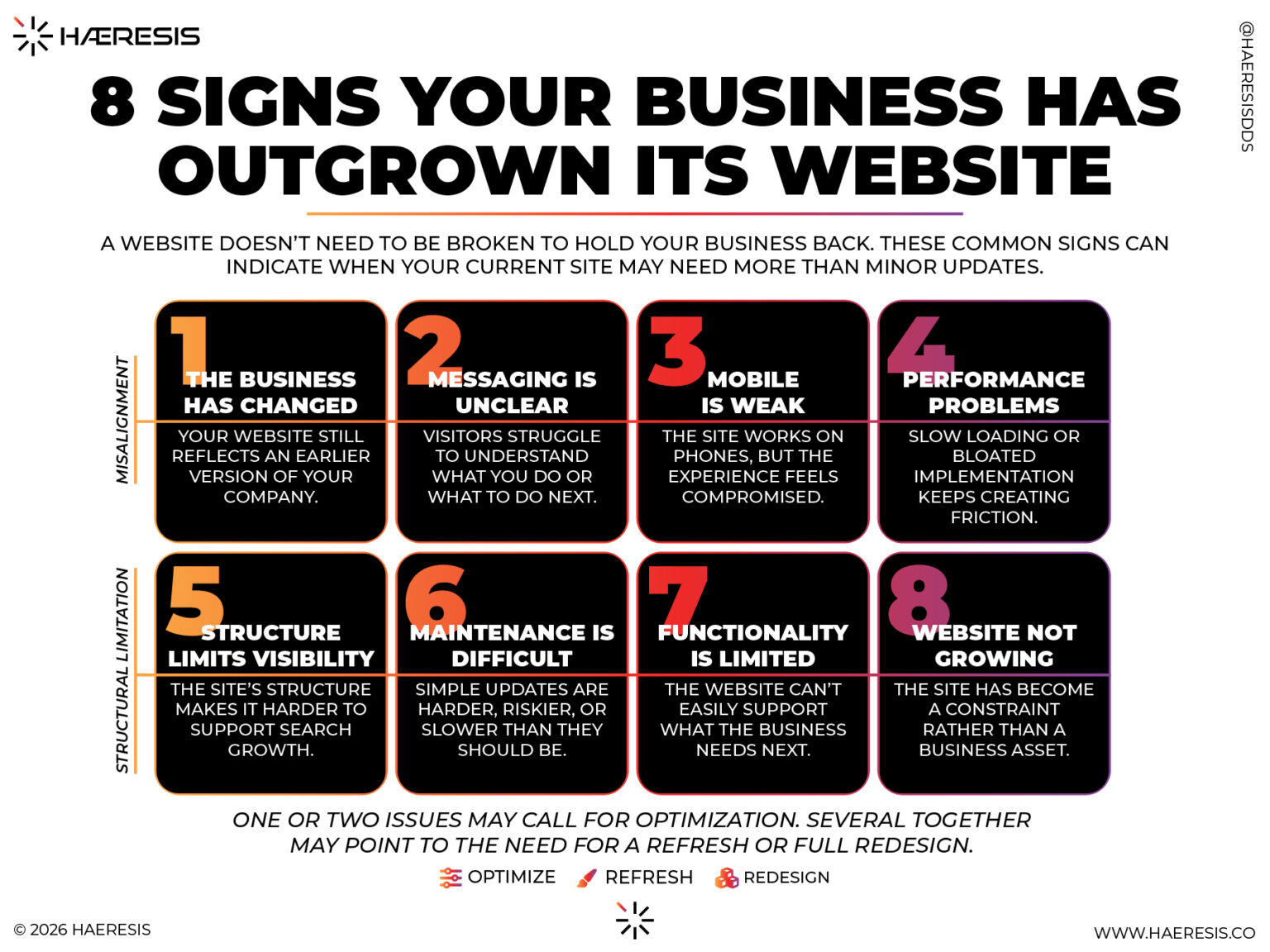
Signs Your Business May Have Outgrown Its Website
Not every issue below automatically means you need a complete rebuild. But when several begin appearing together, continuing to patch the existing website may become less practical than redesigning it around your current needs.
Your Website No Longer Reflects the Business You Operate Today
1.
One of the clearest signs of an aging website is not visual—it is strategic. Perhaps your company launched with three services and now offers eight. Maybe you originally served one market and have since expanded into several. Your target customers may have changed. Your pricing model may have evolved. Your brand may have matured significantly since the website was created. Yet the website still presents the earlier version of the company.
This creates a disconnect. Potential clients are evaluating your business based on an online presence that may no longer accurately communicate your capabilities, positioning, professionalism, or direction. A few content edits can sometimes solve this. But if the navigation, page structure, visual identity, and messaging were all designed around an outdated business model, the underlying website architecture may need to change with the company.
Visitors Have Trouble Understanding What You Do or What to Do Next
2.
A visually attractive website can still be difficult to use. Visitors should be able to quickly determine what your business does, who you help, why your services matter, where to find the information they need, and what action they should take next. If your navigation has become cluttered, services are buried under vague headings, important information is spread across unrelated pages, or visitors routinely ask questions that the website should already answer, the problem may extend beyond copywriting.
As businesses add services and content over time, websites often grow organically rather than strategically. New pages are inserted wherever they seem convenient. Additional menu items accumulate. Calls to action become inconsistent. Eventually, the site may need to be reorganized around the way customers actually evaluate the business today.
The Mobile Experience Feels Like a Compromise
3.
Being technically responsive is not the same thing as providing a good mobile experience. A website may resize itself for a phone while still creating problems such as, crowded navigation, oversized headings, difficult forms, awkward spacing, tiny interactive elements, images that overwhelm the screen, sections that feel unnecessarily long, and desktop layouts simply stacked vertically.
For many businesses, a significant portion of prospective customers will encounter the website first on a mobile device. That makes mobile usability part of the primary experience—not a secondary adaptation of the desktop site. If every mobile improvement requires another workaround, the issue may be rooted in the design system or implementation rather than a handful of individual sections.
Performance Problems Have Become Structural
4.
Website performance problems can often be improved without redesigning the site. Images can be optimized. Caching can be configured. Hosting can be improved. Databases can be cleaned. Scripts can be reduced. But there is a point where poor performance becomes structural. A website may depend on excessive plugins, outdated development practices, bloated templates, unnecessary scripts, poorly implemented animation, or years of accumulated modifications.
At that point, optimization can become an ongoing battle against the way the website was originally constructed. The distinction is important: A slow website does not automatically need to be rebuilt. But if significant effort repeatedly produces only temporary or marginal improvements, rebuilding the site around better performance practices may ultimately be more efficient than continuously compensating for old technical decisions.
Search Visibility Is Being Limited by the Website’s Structure
5.
Search engine optimization is not limited to adding keywords to pages. The organization of the website itself matters. As a business grows, an older website may no longer provide enough structure to properly represent its services, locations, audiences, or areas of expertise. Common problems include multiple important services compressed onto a single broad page, thin or outdated service content, weak internal linking, important pages buried deep within navigation, legacy URL structures, duplicate or overlapping content, and poor relationships between supporting content and commercial pages.
Sometimes these issues can be corrected within the existing site. In other cases, the business has changed enough that a more intentional information architecture is needed. A redesign also needs to be handled carefully when an existing website already has search visibility. Valuable URLs, backlinks, rankings, and indexed content should not simply disappear because the visual design is changing. I’ll cover that process separately in How to Redesign a Website Without Losing Your SEO, because preserving existing search equity deserves its own planning process.
Updating the Website Has Become Unnecessarily Difficult
6.
Your website should not require a minor engineering project every time you need to change a paragraph. Older websites often accumulate technical debt over time. You may notice that simple updates unexpectedly break layouts, nobody remembers why certain plugins are installed, important functionality depends on outdated software, every update creates concern about compatibility, content changes require developer intervention, previous developers created custom systems nobody else understands, or sections must be duplicated and manually modified rather than managed consistently.
This does not necessarily mean the website was poorly built. Sometimes technology simply changes, requirements evolve, and years of modifications create complexity. But maintainability matters. A website that becomes increasingly difficult to manage will cost more time and money over its lifetime, even if visitors never see the underlying problem.
The Website Cannot Support What the Business Needs Next
7.
Sometimes the strongest argument for a small business website redesign has nothing to do with what is wrong today. The question is what the company needs tomorrow. Perhaps you want to introduce appointment booking, E-commerce, memberships, online learning, advanced forms, customer portals, multiple languages, CRM integrations, marketing automation, additional locations or new service divisions.
An existing website can often be extended to support new functionality. But there is a point where adding more systems to an unsuitable foundation becomes unnecessarily complicated. If every new business initiative begins with the question, “Can we somehow make the website handle this?” the website may no longer be supporting growth—it may be dictating the limits of that growth.
The Website Has Become a Constraint on the Business
8.
This is the broader issue behind all the others. A website has probably outgrown its usefulness when people inside the company begin working around it. Perhaps your sales team avoids sending prospects there because it no longer represents the business well. Maybe marketing campaigns require standalone pages because the main website cannot accommodate them. Perhaps the owner feels uncomfortable directing people to the site.
New services may be difficult to explain. New functionality may be difficult to integrate. Search improvements may be constrained by the existing structure. At that point, the strongest reason to redesign the website is not that it looks old. It is that the business can no longer move forward efficiently with the website it has.
Sometimes You Don’t Need a Redesign
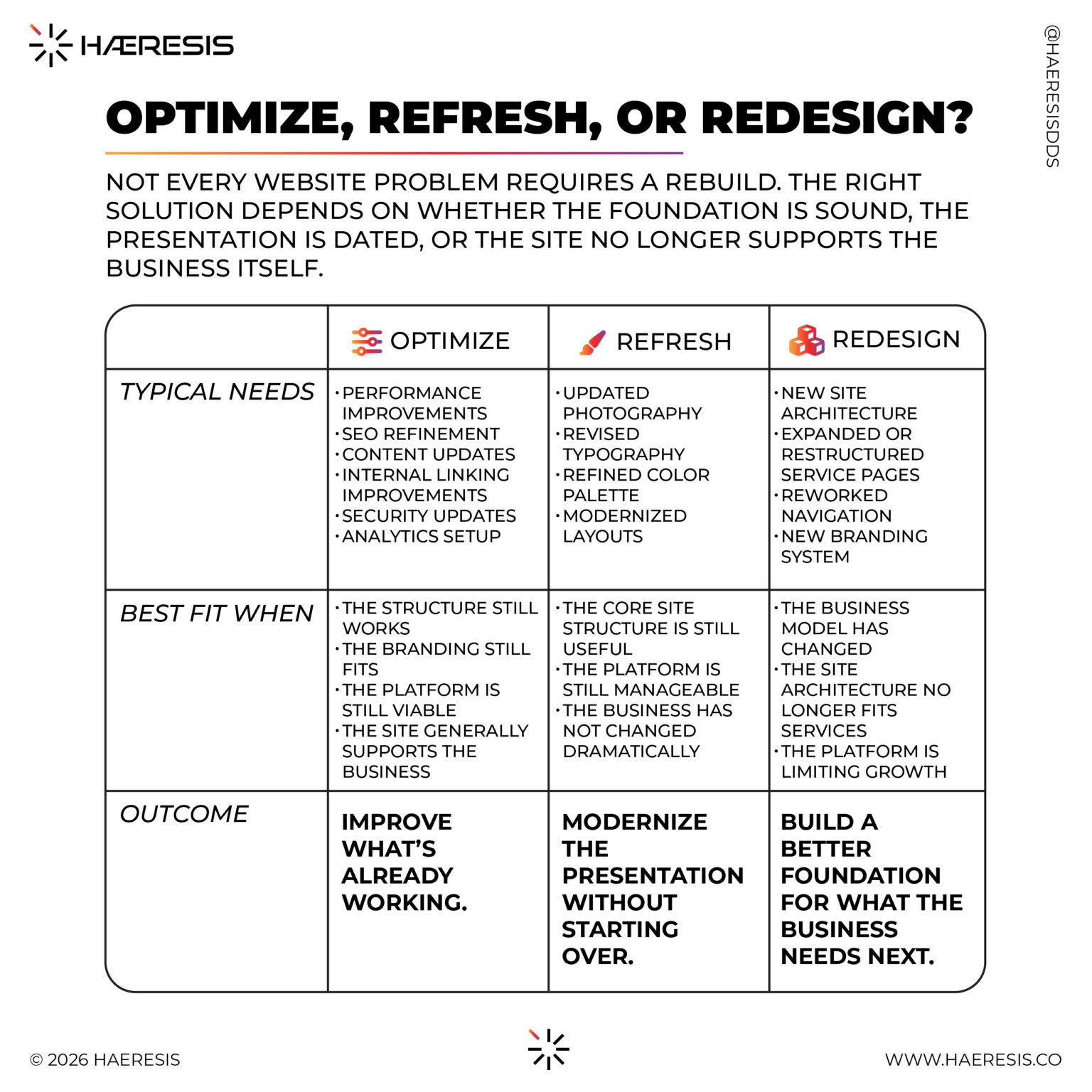
A complete rebuild is not always the best solution. Before deciding to redesign, it helps to distinguish between three different levels of intervention.
Optimization is appropriate when the underlying website remains fundamentally sound.
If the platform, structure, branding, and functionality still fit the business, there may be little reason to replace them.
You may simply need improvements to:
- Performance
- Search visibility
- Content
- Internal linking
- Security
- Maintenance
- Analytics
- Conversion paths
| Situation | Optimize | Refresh | Redesign |
|---|---|---|---|
| Minor performance issues | |||
| Outdated photography or content | |||
| Slightly outdated brand presentation | |||
| Business model has changed significantly | |||
| Site structure no longer fits your services | |||
| Platform cannot support needed functionality | |||
| Strong website with isolated SEO problems | |||
| Multiple structural, technical and branding problems |
A refresh makes sense when the website still has a strong foundation but needs modernization.
The structure remains largely intact while the presentation and content become more current.
That might include:
- Updated photography
- Revised typography
- Refined colors
- Improved page layouts
- Updated messaging
- New calls to action
- Better presentation of existing services
| Situation | Optimize | Refresh | Redesign |
|---|---|---|---|
| Minor performance issues | |||
| Outdated photography or content | |||
| Slightly outdated brand presentation | |||
| Business model has changed significantly | |||
| Site structure no longer fits your services | |||
| Platform cannot support needed functionality | |||
| Strong website with isolated SEO problems | |||
| Multiple structural, technical and branding problems |
A full redesign becomes more appropriate when problems exist across several layers simultaneously.
Rebuilding the site around better performance practices may ultimately be more efficient than continuously compensating for old technical decisions.
You may simply need improvements to:
- Business model has changed
- Architecture no longer fits
- Functionality is limited
- Maintenance is becoming difficult
- Design, performance, SEO, and functionality problems overlap
| Situation | Optimize | Refresh | Rebuild |
|---|---|---|---|
| Minor performance issues | |||
| Outdated photography or content | |||
| Slightly outdated brand presentation | |||
| Business model has changed significantly | |||
| Site structure no longer fits your services | |||
| Platform cannot support needed functionality | |||
| Strong website with isolated SEO problems | |||
| Multiple structural, technical and branding problems |
Managed WordPress Website Solutions
Are You An SMB Looking for a Complete Digital Foundation?
Managed WordPress Website Solutions combine website development, branding, SEO, technical infrastructure, and ongoing support into a structured package designed to help businesses launch and grow with confidence. Not every business requires a fully custom engagement. For those looking for a proven framework that combines the most commonly requested services into a streamlined solution, MWWS packages offer a practical starting point. The only question is how much functionality, visibility, and growth support your business is ready for.
Foundation Website Solution
Best for SMBs that need a polished professional website, brand foundation, SEO-ready structure, and essential digital tools.
Advanced Website Solution
Best for SMBs that need additional functionality to support operations, sales, scheduling, education, or customer interaction.
Complete Website Solution
Best for SMBs that need multiple functionality layers, local visibility support, social media setup, and app-like website capabilities.
What Should You Preserve Before Starting Over?
A small business website redesign should not mean casually throwing away everything the existing website has accumulated. This is especially important for websites with established organic search traffic.
A successful redesign should build on existing value, not unintentionally destroy it. That means content inventories, URL planning, redirect mapping, analytics review, and post-launch monitoring should be part of the redesign process—not afterthoughts once the new site goes live.
Before replacing an established site, identify what is already working. That may include:
High-performing pages
Search rankings
Important URLs
Valuable backlinks
Strong conversion paths
Useful customer behavior data
Brand assets worth retaining
Existing functionality that works well
Content that already answers customer questions effectively
A Better Website Should Solve More Than a Design Problem
A successful small business website redesign should improve much more than appearance. Ideally, the new website should make the business easier to understand, easier to find, easier to manage, and easier to expand.
That means considering brand clarity, information architecture, mobile usability, accessibility, performance, search foundations, content organization, maintainability, business functionality, conversion paths, and scalability.
A good website design is ultimately the coordination of these systems.
A beautiful interface built on weak infrastructure is incomplete.
A technically excellent website that communicates poorly is incomplete.
A fast website that does not support the business model is incomplete.
The strongest redesigns solve these problems together.
I Recently Faced the Same Decision With Haeresis
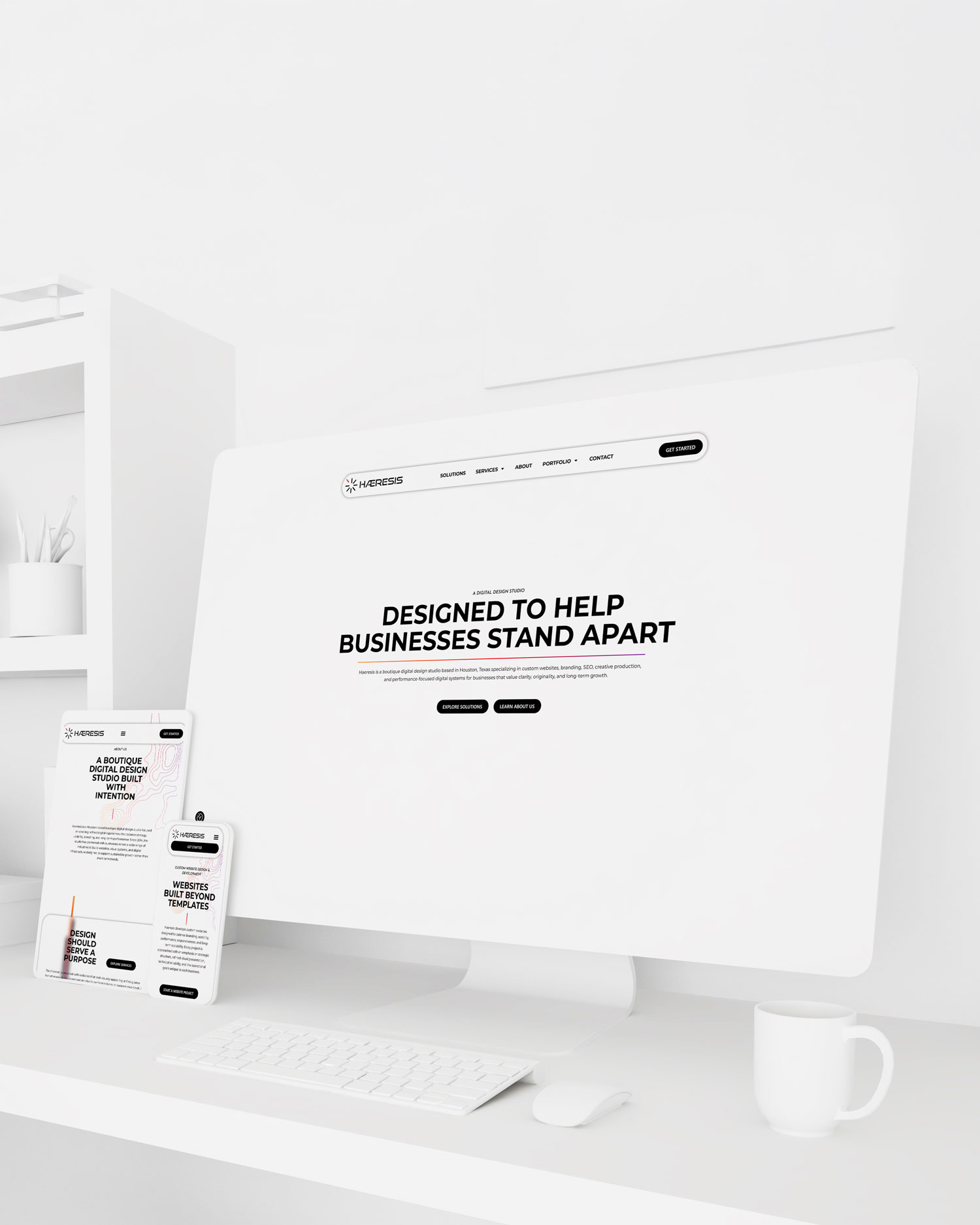
The recent redesign of the Haeresis website was a useful reminder that even web designers eventually have to evaluate their own websites using the same criteria.
The previous site was not being replaced simply because it had reached a certain age.
The business itself had changed.
Haeresis had expanded its service offerings, developed a larger portfolio, formalized its Managed WordPress Website Solutions, strengthened its approach to search visibility and analytics, and needed a site architecture capable of supporting a much more intentional long-term content strategy.
The old website could have continued functioning.
But continuing to modify it would have meant designing around decisions made for an earlier version of the business.
The redesign created an opportunity to reconsider the website as a complete system: services, portfolio, branding, navigation, search structure, conversion tracking, performance, content, and future growth.
That is the distinction I encourage business owners to make.
A redesign should not be undertaken simply because something newer would look better.
It should create a better foundation for what the business needs next.
Has Your Business Outgrown Its Website?
If your website is still doing its job well, there may be no compelling reason to replace it. But if your business has evolved while the website remains anchored to an earlier version of the company, it is worth looking beyond cosmetic updates.
The right question is not:
“Is this website old?”
It is:
“Is this still the right website for the business we are becoming?”
If the answer is increasingly no, a thoughtful small business website redesign may be less about starting over and more about building the digital foundation your company now requires.
Explore Haeresis Custom Website Design & Development to learn more about our approach to building websites around business strategy, branding, usability, performance, search visibility, and long-term growth.
Or, if you are not yet sure whether your website needs to be rebuilt, refreshed, or optimized, start a conversation about your current site and what you need it to do next.